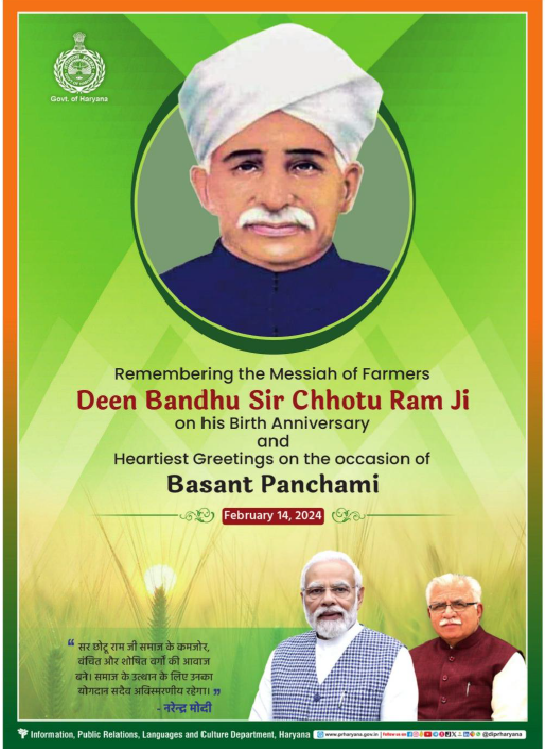
Government of Haryana Pays Tribute to Deen Bandhu Sir Chhotu Ram Ji in The Tribune
The Government of Haryana published this tribute advertisement in The Tribune newspaper on 14th February 2024 to honor the legacy of Deen Bandhu Sir Chhotu Ram Ji, one of the most revered agrarian reformers and social champions of pre-independent India. The ad was prominently placed to reach English-speaking readers across Delhi and the National Capital Region.
Newspaper: The Tribune
Date of Publication: 14-02-2024
Publishing City: Delhi
Publishing Page: Tribune Main Page
About Deen Bandhu Sir Chhotu Ram Ji
Born on 24th November 1881 in Garhi Sampla, Rohtak district (now Haryana), Sir Chhotu Ram rose from humble beginnings to become a towering figure in colonial India’s agrarian and social reform movements. Fondly known by titles such as Deenbandhu (Friend of the Poor), Rahbar-e-Azam, and Kisano ke Maseeha, he dedicated his life to the welfare of farmers and the rural poor.
Some of his most significant contributions include:
- Co-founding the National Unionist Party in 1923 to represent the collective interests of Hindu, Muslim, and Sikh agriculturists
- Introducing landmark legislation including the Punjab Relief of Indebtedness Act (1934), the Punjab Debtors’ Protection Act (1936), and the Punjab Restitution of Mortgaged Lands Act (1938) to protect farmers from exploitative moneylenders
- Establishing the Punjab Agricultural Produce Markets Act which laid the foundation for modern agricultural market systems
- His instrumental role in the conceptualization of the Bhakra Nangal Dam Project, earning him recognition as the Father of Bhakra Dam
- Founding the Jat Anglo Sanskrit Sansthan in 1913 to promote education among rural communities
- Allocating a significant portion of his ministerial salary to fund scholarships for students from economically disadvantaged backgrounds
He was honored with several prestigious titles including Rai Bahadur (1919), Deenbandhu (1942), and Rehbar-e-Azam (1944). The Government of India issued a commemorative stamp in his honor in 1995. A 64-foot statue at Sampla, Haryana, was unveiled by Prime Minister Narendra Modi in 2018 as a tribute to his enduring legacy.
Why the Government of Haryana Publishes Such Advertisements
The Government of Haryana regularly publishes tribute and public awareness advertisements in leading newspapers to commemorate the birth and death anniversaries of great personalities, share policy updates, and keep citizens informed about government schemes and initiatives. These advertisements are an important means of connecting with the people of Haryana and beyond.
Choosing The Tribune for such commemorations is a deliberate decision, given the newspaper’s deep historical roots and wide reach across North India. The Tribune has been publishing since 1881 and is considered the most trusted English daily in the region, particularly in states like Punjab, Haryana, Himachal Pradesh, and Delhi.
Why Advertise in The Tribune Newspaper
The Tribune is one of the most respected and widely circulated English newspapers in North India. For government bodies, institutions, and businesses targeting audiences across Delhi, Chandigarh, Punjab, Haryana, and Himachal Pradesh, it remains an ideal advertising platform. Here are some key reasons why advertisers choose The Tribune:
- Massive Readership: The Tribune enjoys a large and loyal reader base, including educated, decision-making, and economically active citizens.
- Credibility and Trust: With over 140 years of publication history, it carries strong editorial credibility that rubs off on advertisements placed within it.
- Targeted Geographic Reach: It is the go-to newspaper for readers in Delhi NCR, Chandigarh, and the entire North Indian belt.
- Multiple Ad Formats: Advertisers can choose from Classified Ads, Display Ads, Full Page Ads, Half Page Ads, Jacket Ads, and Solus Ads depending on their budget and objective.
- Cost-Effective Options: Compared to national dailies, The Tribune offers competitive rates with strong local penetration.
- Wide Category Coverage: The Tribune accepts advertisements across diverse categories including Government Notices, Recruitment, Obituary, Education, Real Estate, Matrimonial, Tenders, and more.
Advertisement Categories Available in The Tribune
Whether you are a government department, a corporate body, or an individual, The Tribune accepts advertisements under a wide range of categories:
- Government and Public Notice Advertisements
- Recruitment and Job Advertisements
- Obituary and Death Notices
- Education and Admissions
- Real Estate – Property Sale and Rent
- Tender Notices
- Matrimonial – Wanted Bride and Wanted Groom
- Financial Results and Announcements
- Health Care and Pharma
- Automotive, Electronics, and Consumer Products
- Name Change and Lost and Found
- Social Awareness Campaigns
How to Book an Advertisement in The Tribune
Booking an advertisement in The Tribune is now easier than ever. You can place your ad online from the comfort of your home or office. Whether it is a classified text ad or a large display ad, the booking process is simple and transparent.
To get started, you can place your Tribune advertisement online and choose from a variety of ad formats and page positions based on your requirement and budget.
Before booking, it is always a good idea to review the latest pricing. You can check The Tribune newspaper ad rates to plan your advertising budget effectively and choose the right format for your campaign.
About This Advertisement
This Government of Haryana tribute advertisement was published in the Main Page of The Tribune, Delhi edition, on 14th February 2024. Display advertisements like this one are charged on a per square centimeter basis by The Tribune. The total cost depends on the size of the ad and the page it is published on, with premium positions such as the Front Page and Main Page attracting higher rates.
Display advertisements stand out from classified ads as they appear alongside editorial content and can incorporate rich visual design, photographs, and branding elements, making them ideal for government tributes, institutional announcements, and brand campaigns that demand high visibility.