Advert Gallery · Political Satire / Social Commentary Advertisement
Cockroach Janata Party – Five-Point Agenda Advertisement Analysis & Political Satire Case Study
Overview
Advertisement at a Glance
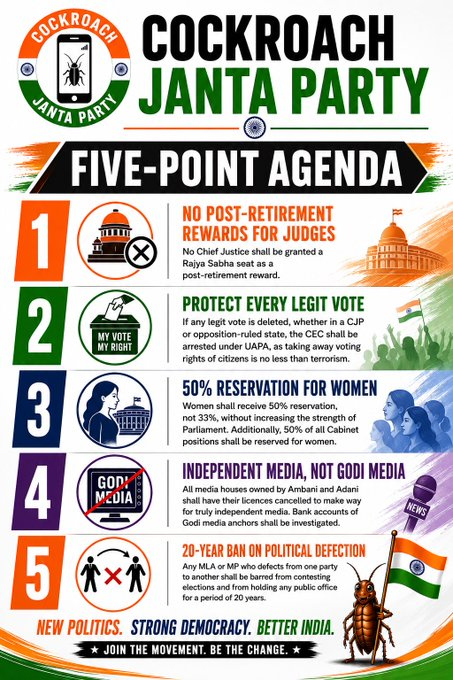
The “Cockroach Janata Party – Five-Point Agenda” advertisement is a satirical political-style campaign creative that uses humor, symbolism and strong visual messaging to comment on governance, democracy, electoral reforms and media independence in India.
The poster mimics the look and feel of a political party election manifesto while presenting exaggerated yet thought-provoking policy ideas under the fictional identity of the Cockroach Janata Party (CJP).
The advertisement uses bold typography, tricolour-inspired visuals, political symbols and issue-based messaging to attract immediate attention and encourage public debate.
What is Cockroach Janata Party?
Understanding the Subject Behind the Advertisement
The Cockroach Janata Party appears to be a fictional or symbolic political concept created as a form of political satire and public commentary rather than an officially recognized political party.
The use of the word “Cockroach” is symbolic and likely intended to represent survival, persistence, adaptability or criticism of political culture. Satirical political campaigns often use unusual names, parody logos and exaggerated promises to attract attention and encourage people to think critically about governance and democratic systems.
This advertisement reflects themes commonly discussed in public discourse such as:
- Judicial independence
- Electoral transparency
- Women’s political representation
- Media neutrality and press freedom
- Political defections and accountability
Such campaign-style satire has become increasingly common in digital culture, meme-based activism and social media-led political commentary.
Ad Analysis
Complete Analysis of the Five-Point Agenda Advertisement
The creative is designed to resemble a real political manifesto poster with numbered agenda points, patriotic colour palettes and election-style typography.
The advertisement prominently features five policy statements presented as reforms intended to improve democracy and governance.
The Five Agenda Points Mentioned
- No post-retirement rewards for judges
- Protect every legitimate vote
- 50% reservation for women
- Independent media, not “godi media”
- 20-year ban on political defection
The campaign uses sharp, direct language to spark emotional response and debate. The inclusion of national colours, parliament imagery and voting symbolism reinforces the political atmosphere of the design.
Creative Strategy
Creative & Visual Communication Strategy
Satirical Political Branding
The advertisement imitates a political election campaign to instantly capture public attention.
High-Contrast Colours
The use of saffron, green, white and bold black typography creates strong visibility and national political association.
Issue-Based Storytelling
Instead of promoting a product, the advertisement promotes political ideas and public debate through agenda-driven communication.
Humour + Serious Messaging
The unusual party name adds humour while the policy issues themselves remain serious and socially relevant.
Social Media Friendly Design
The vertical poster format, bold icons and simple messaging make the creative highly shareable across WhatsApp, Instagram, X and Facebook.
Themes & Public Discourse
Major Themes Highlighted in the Advertisement
- Judicial ethics and independence
- Protection of voting rights
- Women empowerment in politics
- Media independence and accountability
- Political reform and anti-defection debate
- Public frustration with traditional politics
- Democracy and citizen participation
- Satirical activism through design
Target Audience
Who is the Advertisement Targeting?
- Youth interested in politics and governance
- Social media audiences
- Urban educated readers
- Political discussion communities
- Citizens interested in democratic reforms
- Satire and meme culture followers
- Activists and public policy observers
- People critical of current political systems
Communication Impact
Why This Advertisement Gets Attention
The campaign succeeds because it combines humour, controversy, bold visuals and emotionally charged public issues in one creative format.
Even people who disagree with the messaging are likely to stop and read the advertisement because of its provocative presentation and unconventional branding.
- Strong visual contrast
- Highly readable numbered format
- Political symbolism creates curiosity
- Satire improves virality
- Bold messaging encourages debate
- Easy to understand agenda structure
- Social media-friendly layout
- Emotionally provocative communication
Advertising Perspective
Advertising & Branding Learnings from This Campaign
For Political Campaigners
Simple issue-based communication often performs better than long ideological messaging.
For Designers
Strong typography and visual hierarchy can dramatically improve poster readability.
For Social Campaigns
Satire and humour can increase engagement with serious public issues.
For Marketers
Controversial or unconventional branding attracts immediate attention and discussion.
For Advertisers
Issue-led communication creates stronger emotional connection than generic promotional content.
For Content Creators
Political meme culture and visual activism are becoming powerful communication formats online.
Cultural & Media Relevance
Role of Political Satire in Modern Advertising Culture
Political satire has increasingly become part of digital advertising culture, online activism and social commentary. Posters like this blur the line between campaigning, entertainment and public discourse.
Such creatives often gain traction because they simplify complicated political debates into visual narratives that are easy to consume and share online.
Whether viewed as humour, criticism or activism, the “Cockroach Janata Party” advertisement demonstrates how graphic design and political messaging can combine to generate public engagement.
Advert Gallery
About Advert Gallery
Advert Gallery is a platform that showcases creative, impactful and unique advertisements published across newspapers, digital media and public campaigns.
The platform documents advertising trends, political campaigns, social messaging, obituary creatives, corporate branding and public awareness advertisements from across India.
Why Such Advertisements Matter
- ◆They reflect public opinion and social mood
- ◆They showcase evolving political communication styles
- ◆They demonstrate creative use of satire in advertising
- ◆They encourage democratic discussion and debate
- ◆They show how design influences public engagement
Advert Gallery documents memorable campaigns from categories including: